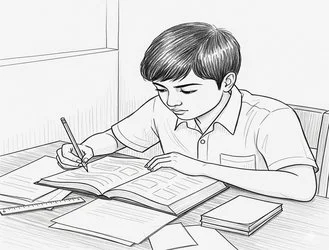
The IAS (Indian Administrative Service) remains India's most aspirational career - the power to run districts, shape policy, and serve at the highest levels of government. Around 10 lakh candidates apply for the UPSC Civil Services Examination each year; roughly 1,000 make the final list, and only the top ~180 or so get IAS. Daunting? Yes. Mysterious? It shouldn't be. Here's the complete roadmap.
1. Eligibility: Simpler Than Most Think
- Education: Any bachelor's degree, any stream, any marks - a pass is enough
- Age: 21-32 for General (as of the application year), with relaxations - OBC +3 years, SC/ST +5
- Attempts: 6 for General, 9 for OBC, unlimited for SC/ST (within age limits)
2. The Three-Stage Exam
- Prelims (June): Two objective papers - GS Paper 1 (100 questions: history, polity, geography, economy, environment, science, current affairs) decides your qualification; CSAT Paper 2 is qualifying (33%). Negative marking of one-third. Roughly 12,000-14,000 clear.
- Mains (September): Nine descriptive papers over a week - Essay, four GS papers, two Optional subject papers, plus qualifying English and regional language papers. This is where the exam is truly won: 1,750 marks of pure writing.
- Interview/Personality Test (Feb-April): 275 marks - a 30-minute board assessment of judgement, honesty, and awareness, not knowledge quizzing.
3. The Foundation: What to Study First
- NCERTs (Class 6-12): History, Geography, Polity, Economy, Science - the universal starting point, 3-4 months
- Standard books: Laxmikanth (Polity - the exam's bible), Spectrum (Modern History), GC Leong + NCERT (Geography), an economy source (Ramesh Singh or current-affairs-driven notes), Shankar IAS (Environment)
- Newspaper: The Hindu or Indian Express daily - one hour, notes by topic. Current affairs now drives a majority of Prelims and Mains questions.
- PYQs: Ten years of Prelims and Mains papers - study them in month one, not month twelve, to understand what UPSC actually asks
4. The Optional Subject: Choose Like a Strategist
Your optional contributes 500 Mains marks and often decides selection. Choose based on: genuine interest (you'll spend 500+ hours), overlap with GS (Public Administration, Geography, Sociology, Political Science, History), availability of guidance/material, and your academic background (many science graduates still pick humanities optionals for overlap and scoring trends). Never pick an optional just because a topper did.
5. Answer Writing: The Real Differentiator
Mains rewards structured, balanced, example-rich answers produced at high speed - 20 answers in 3 hours. From month 4-5 onwards, write 2-3 practice answers daily and join a test series for evaluation. Essay practice (2 per month) compounds too. The single most common failure mode is aspirants who read for two years but never trained the writing muscle.
6. Realistic Timelines
- College students: Start light in 2nd-3rd year (NCERTs + newspaper), go serious in final year - graduates who prepared alongside college dominate the young-topper lists
- Full-time aspirants: 12-15 months of structured prep for the first serious attempt: 6-7 months syllabus + current affairs, 3 months Mains writing, 2-3 months Prelims-specific mocks and revision
- Working professionals: 2-year runway with 3-4 disciplined daily hours - a well-trodden and successful path
- Coaching is optional; toppers increasingly rely on self-study plus test series. What's non-negotiable: PYQs, current affairs consistency, and evaluated writing practice.
7. Rank, Service and the Life After
Your rank determines service allocation - IAS and IFS go earliest, then IPS, IRS, and other central services (all excellent careers - have genuine respect for the whole basket, since demanding "IAS or nothing" wastes attempts). Selected candidates train at LBSNAA Mussoorie, then serve as SDM in a district - at 24-26 years old, administering lakhs of people. Pay starts at Level 10 (₹56,100 basic) with housing, staff, and the widest canvas any Indian career offers.
UPSC is not an intelligence test - it's a consistency test with a syllabus. Start with NCERTs and a newspaper today, respect the PYQs, train your writing early, and give it two honest years before judging yourself. Every collector was once a confused aspirant reading a roadmap like this one.
FAQ
What is this guide about: How to Become an IAS Officer: Complete UPSC CSE Roadmap from School to LBSNAA?
The complete path to becoming an IAS officer - UPSC CSE eligibility, three-stage exam explained, optional subject choice, booklist, timeline planning, and life as a civil servant.
How can students use this guide effectively?
Read the key sections, apply the step-by-step recommendations, and create a weekly action plan to track progress.
Where can I find tutors for personalized support?
You can use Tuition.in to find verified tutors by subject and city, compare profiles, and choose tutors based on reviews and experience.
Related Topics

Written by Sanya Mirchandani (Ex-Civil Servant)
Expert educator and content creator passionate about making quality education accessible to all students across India.
Found this helpful? Share it!
Share Your Thoughts
Your email address will not be published. Help other students and parents by sharing your experience. Required fields are marked *